India’s new telecom authorisation regime has introduced a clearer regulatory framework for enterprise communication platforms, cloud telephony providers and CPaaS businesses.
One of the important categories under this framework is Enterprise Communication Service (ECS) Authorisation.
The ECS Authorisation has been introduced under the Telecommunications (Authorisation for Provision of Miscellaneous Telecommunication Services) Rules, 2026, notified by the Department of Telecommunications on 23 June 2026.
What is Enterprise Communication Service or ECS?
Enterprise Communication Service (ECS) is a telecom authorisation that permits an eligible entity to commercially provide specified communication services to enterprises and other users across India.
Under the current DoT framework, ECS covers four main categories of services:
- Audio Conferencing
- Audiotex
- Cloud-based EPABX / CPaaS
- Voice Mail
The DoT specifically states that an ECS-authorised entity may provide these defined services on a commercial basis, but it cannot automatically provide other telecom services unless separately authorised.
Why is ECS Important?
Enterprise communications have changed significantly over the last few years.
Businesses increasingly use:
- Cloud telephony
- CPaaS platforms
- Hosted PBX systems
- Contact-centre platforms
- Voice APIs
- Audio conferencing
- Enterprise calling applications
- Unified communication platforms
Earlier, many such companies largely depended upon commercial arrangements with licensed telecom operators and operated as enterprise customers or application providers.
The 2026 authorisation regime now provides a specific regulatory category for defined enterprise communication services.
This creates an important distinction between an ordinary enterprise customer purchasing telecom connectivity and an entity that is itself providing an authorised telecom service.
Services Covered under ECS
Audio Conferencing
Audio conferencing enables multiple participants to communicate through a common voice-conferencing platform.
Such services are widely used by enterprises for meetings, customer interactions and business communications.
Audiotex
Audiotex allows users to access interactive or recorded voice-based information through telecommunications networks.
Examples may include information services, automated voice applications and other permitted interactive voice services.
Cloud-based EPABX / CPaaS
This is particularly important for the cloud communications industry.
A traditional EPABX is normally installed physically at an enterprise location.
A cloud-based EPABX moves PBX functionality into a hosted or cloud environment.
Modern CPaaS platforms may additionally provide APIs and software capabilities that enable enterprises to integrate voice and communication functionality into their business applications.
DoT expressly includes cloud-based EPABX/CPaaS within the scope of ECS Authorisation.
Voice Mail
ECS also covers voice-mail services linked with telecommunications identifiers and enterprise communication systems.
ECS is an All-India Authorisation
One of the significant features of ECS is that its service area is:
National — covering the whole of India.
Therefore, unlike certain access-service authorisations that operate on an LSA-wise basis, ECS is structured as an All-India authorisation.
The initial validity period is 20 years, with renewal provisions under the applicable Rules.
Who Should Examine ECS Authorisation?
The ECS framework is particularly relevant for companies involved in:
- CPaaS
- UCaaS
- CCaaS
- Cloud telephony
- Hosted EPABX
- Enterprise voice platforms
- Audio conferencing
- Voice-mail services
- Enterprise communication applications
However, merely describing a business as a CPaaS or UCaaS platform does not by itself determine the required authorisation.
The actual requirement depends upon the network architecture, telecom resources being used, nature of service being provided, numbering resources, relationship with telecom operators and whether the entity is providing access services or only enterprise communication functionality.
ECS vs VNO Wireline Access Authorisation
This is an important regulatory distinction.
A company providing only services falling within the ECS scope may consider a standalone Enterprise Communication Service Authorisation.
However, a company that wishes to operate as a broader telecom access provider may require a VNO Wireline Access Service Authorisation or another applicable principal service authorisation.
Under the 2026 Principal Telecommunication Services Rules, a VNO holding Wireline Access Service Authorisation may also provide Enterprise Communication Services. In such a case, the applicable ECS conditions contained in the Miscellaneous Telecommunication Services Rules also apply unless specifically provided otherwise.
This creates two broad regulatory models:
Standalone ECS Model
Enterprise Customer
↓
ECS Authorised Service Provider
↓
Authorised Telecom Network / Connectivity Provider
VNO Wireline Access Model
Enterprise Customer
↓
VNO Wireline Access Provider
↓
Parent NSO / Telecom Network
The appropriate model must therefore be determined based on the actual business and technical architecture.
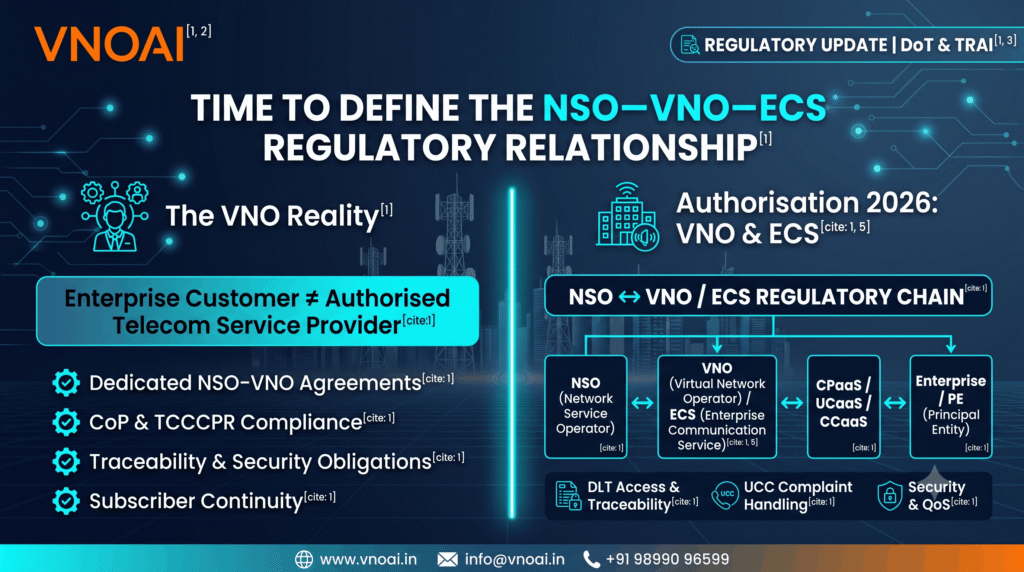
Why the NSO–ECS Relationship is Important
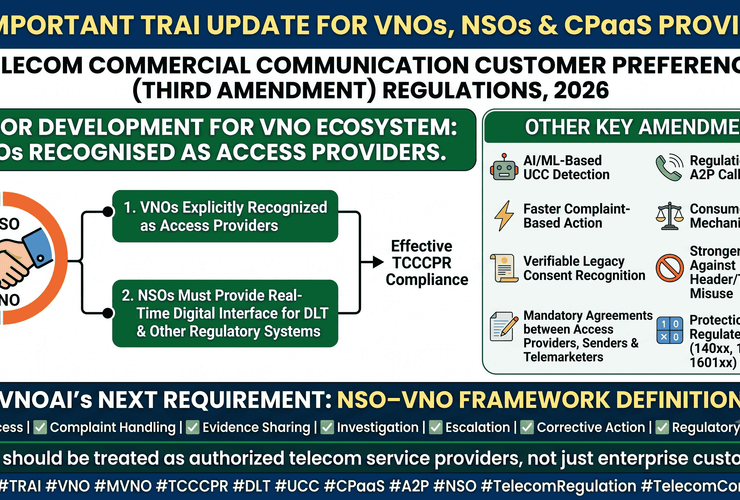
A major practical issue under the new regime is how Network Service Operators and telecom operators recognise ECS-authorised entities.
An ECS-authorised entity should not automatically be viewed in exactly the same manner as an ordinary enterprise customer where it is itself providing an authorised telecommunications service.
Commercial and operational arrangements between telecom operators and ECS providers may therefore need to appropriately reflect:
- the authorised status of the ECS provider;
- telecom resource provisioning;
- regulatory responsibilities;
- security requirements;
- customer identification obligations, where applicable;
- TCCCPR and UCC-related responsibilities;
- complaint-handling processes;
- DLT-related requirements; and
- lawful and authorised use of telecom identifiers and network resources.
This is an area where industry alignment between authorised entities and Network Service Operators will be important.
ECS and TCCCPR Compliance
Entities providing enterprise communication services may also need to examine their responsibilities under the Telecom Commercial Communications Customer Preference Regulations, 2018 (TCCCPR) and subsequent amendments, depending upon the communication services and use cases being supported.
For example, a CPaaS or enterprise communication platform supporting promotional, service or transactional communications for enterprises may interact with:
- Principal Entities
- Telemarketers
- Access Providers
- DLT platforms
- telecom resource providers
Therefore, obtaining ECS Authorisation should not be viewed as the end of regulatory compliance.
The company must also evaluate applicable obligations arising from TRAI regulations, DoT directions, cybersecurity requirements, user-identification requirements and other telecom regulations.
ECS Does Not Automatically Replace Every Telecom Authorisation
Another important point is that ECS is a specific-purpose authorisation.
It does not automatically authorise:
- public mobile services;
- general fixed-access services;
- Internet services;
- National Long Distance services;
- International Long Distance services;
- unrestricted allocation or use of telecom numbering resources; or
- other telecom services outside its defined scope.
Where an entity proposes to provide additional telecommunications services, the relevant separate authorisation may be required.
DoT expressly states that only services defined under the ECS Authorisation can be provided under it unless separate approval or authorisation is available.
What Existing CPaaS and Cloud Telephony Companies Should Do
Companies currently operating CPaaS, UCaaS, CCaaS or cloud telephony platforms should conduct a regulatory assessment covering:
- present business model;
- telecom connectivity arrangements;
- relationship with NSOs/TSPs;
- DID and SIP resources;
- numbering resources;
- call routing architecture;
- data centres and cloud infrastructure;
- customer onboarding model;
- enterprise communication services being offered;
- TCCCPR/DLT responsibilities;
- user identification requirements; and
- whether ECS, VNO Wireline Access or another authorisation is most appropriate.
The objective should be to align the commercial and network architecture with the 2026 authorisation regime rather than merely converting an existing enterprise telecom arrangement into a new contract.
Conclusion
The introduction of Enterprise Communication Service Authorisation is an important development in India’s telecom regulatory framework.
It formally recognises services such as Audio Conferencing, Audiotex, Cloud-based EPABX/CPaaS and Voice Mail within an All-India telecom authorisation structure.
For CPaaS, UCaaS, CCaaS and cloud-telephony providers, the key question is no longer only whether telecom connectivity is available from an operator.
The more important regulatory question is:
What role is the company actually performing in the telecom ecosystem, and which authorisation correctly matches that role?
A careful assessment of the company’s service model, network architecture and relationship with the NSO is therefore essential before selecting between standalone ECS Authorisation, VNO Wireline Access Authorisation or another applicable authorisation.