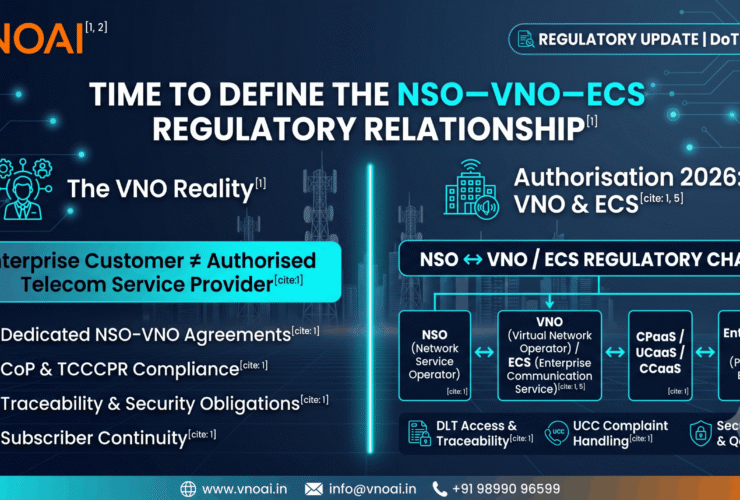
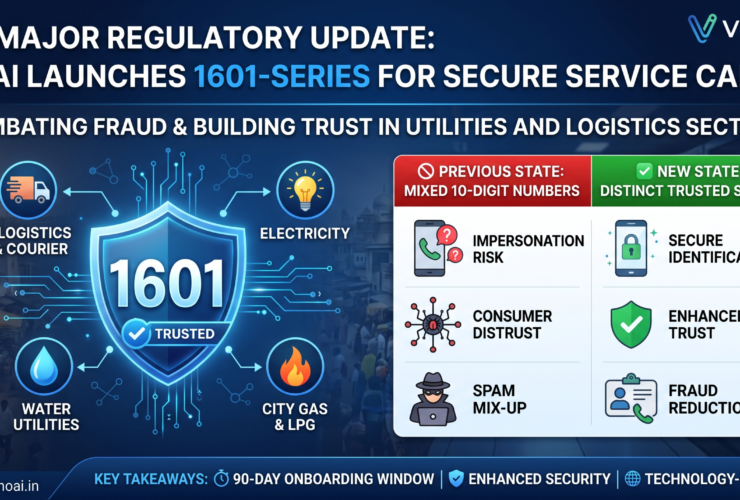
TRAI’s Third Amendment Regulations, 2026 introduce AI/ML-based UCC enforcement, regulation of A2P calls, stronger complaint handling, new safeguards for Headers and Templates, and—significantly—a real-time DLT interface for VNOs.
The Telecom Regulatory Authority of India (TRAI) has further strengthened India’s framework for controlling Unsolicited Commercial Communications (UCC) through the Telecom Commercial Communication Customer Preference (Third Amendment) Regulations, 2026.
The amendments strengthen the existing Telecom Commercial Communications Customer Preference Regulations, 2018 (TCCCPR, 2018) with increased use of technology, stronger enforcement mechanisms and greater accountability across the commercial communication ecosystem.
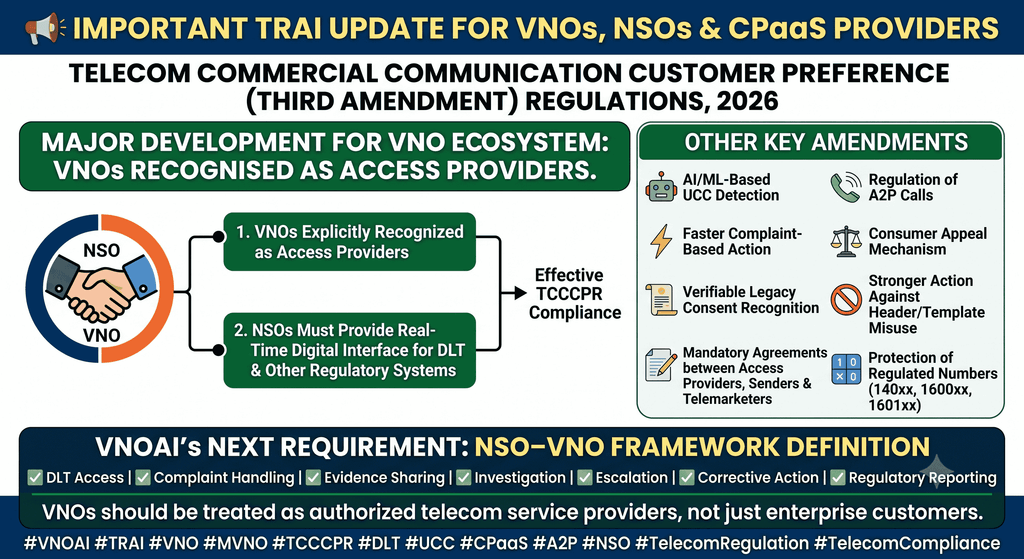
For the VNO ecosystem, one provision is particularly significant:
TRAI has expressly recognised VNOs as Access Providers under the regulatory framework and requires NSOs to provide VNOs with a real-time digital interface to the DLT platform and other systems necessary for regulatory compliance.
This is an important development for establishing a more workable NSO–VNO compliance relationship.
Why the Amendment Matters
Commercial communications today involve multiple participants:
Principal Entity → Telemarketer / CPaaS Platform → VNO / Access Provider → NSO → Consumer
Effective regulation of UCC therefore requires more than subscriber complaints alone. It requires:
- identification of originating telecom resources;
- access to DLT information;
- traceability;
- consent verification;
- complaint investigation;
- exchange of evidence;
- corrective action; and
- regulatory reporting.
The latest amendments attempt to strengthen each of these elements.
1. AI/ML-Based Detection Becomes Part of the Regulatory Framework
TRAI has incorporated AI/ML-based suspected-UCC detection into TCCCPR.
Access Providers will use intelligence generated through such systems to identify CLIs having a high probability of being used for UCC and share relevant information among service providers.
Where five or more CLIs associated with a Sender are flagged within ten days, further investigation and graded regulatory action may follow, including:
- KYC re-verification;
- physical verification;
- barring of outgoing services; and
- disconnection in cases involving repeated violations or misuse of telecom resources.
This represents an important shift from predominantly complaint-driven enforcement towards data- and intelligence-supported enforcement.
2. Application-to-Person (A2P) Calls Brought Under Specific Regulation
The amendment also addresses Application-to-Person or A2P calls.
TRAI defines these as voice calls initiated by an application, software system or automated platform without direct human dialling, including:
- autodialling;
- robo-calls; and
- pre-recorded or artificial-voice calls.
Entities using A2P calling must pre-declare their use of A2P calls to their TSP along with details of the CLIs being used.
A2P calls made without the required prior declaration will be treated as UCC.
This development is particularly relevant for businesses operating CPaaS, cloud communication and automated enterprise communication platforms.
3. Commercial Communication Following Customer Inquiry
TRAI has also clarified the conditions under which commercial communication may follow an inquiry initiated by a customer.
Such communication may continue for seven days from the date of inquiry.
However, the inquiry must have been made:
- in writing; or
- through digital means,
and the Sender must maintain it in a verifiable form.
This provision is intended primarily to facilitate e-commerce and e-service platforms while preventing misuse of customer inquiries for unrestricted promotional communication.
4. Consumers Get an Appeal Mechanism
Consumers will now be able to appeal against the resolution of a UCC complaint.
The appeal may be preferred within 15 days before the Appellate Authority and can be initiated through the mechanisms available for UCC complaints, including the DND application, TSP applications/portals and 1909, subject to the applicable regulations.
This strengthens consumer protection by introducing another level of review into the UCC complaint-handling process.
5. Faster Complaint-Based Enforcement
TRAI has also strengthened the mechanism for acting against suspected UCC Senders.
Earlier, the framework provided for a threshold of five or more unique complaints within ten days.
Under the new mechanism, action can be triggered where:
three or more unique complaints are received within ten days AND the concerned Sender’s CLI is also identified by the AI/ML-based system as having a high probability of sending UCC.
The amendment therefore combines consumer complaints with technological detection to support faster intervention.
6. Legacy Consent Can Be Recognised—Subject to Verification
TRAI has expanded the consent framework to accommodate certain legacy consents already held by entities.
However, such consent will be recognised only where:
- it was obtained through verifiable means; and
- it is subsequently registered on the TSP’s digital platform.
This provides a pathway for existing consent records while preserving the requirement for verifiability and digital registration.
7. Stronger Action Against Misuse of Headers and Content Templates
The amendment introduces stricter action in cases involving misuse of registered Headers or Content Templates.
Once the Originating Access Provider becomes aware of misuse, the misused Header or Content Template is required to be suspended within the prescribed framework, including a six-hour requirement identified in TRAI’s press release.
Where misuse is attributed to a Telemarketer, the regulations provide for serious consequences, including disconnection of telecom resources across TSPs for one year and blacklisting.
This substantially increases the importance of maintaining strong controls over Header and Template usage.
8. Essential Conditions May Be Mandated in Agreements
One of the important structural changes concerns agreements between Access Providers and Senders/Telemarketers.
TRAI notes that contractual arrangements have not always incorporated sufficiently strict conditions to ensure regulatory compliance.
The Authority has therefore introduced a provision enabling it to prescribe essential conditions that must form part of agreements between Access Providers and Senders/Telemarketers.
This reinforces an important principle:
Regulatory compliance must be reflected in the contractual framework—not merely in internal processes.
9. Different Categories of Senders May Face Different Enforcement Measures
TRAI has recognised that not all Senders are similarly placed.
Factors may include:
- criticality of services;
- sector of operation;
- economic importance;
- scale;
- extent of telecom-resource usage; and
- potential consumer impact of suspension or disconnection.
The Authority may accordingly classify Senders into different categories and prescribe differentiated enforcement measures.
This could enable more proportionate enforcement depending upon the nature and impact of the entity concerned.
10. Protection for 140xx, 1600xx and 1601xx Numbering Series
Call Management Applications will not be permitted to indiscriminately block, filter or spam-tag calls originating from regulated numbering series such as:
140xx — regulated promotional communications
1600xx / 1601xx — service and transactional communications
TRAI’s objective is to reduce the risk of genuine regulated commercial or government communications being incorrectly labelled as spam.
Consumers, however, continue to retain the ability to block or filter calls on their own devices.
11. Major Development for VNOs: Real-Time DLT Interface
For VNOAI and the VNO industry, this is perhaps the most significant provision in the amendment.
TRAI states that:
VNOs are also Access Providers under the regulatory framework.
Accordingly, the Network Service Operator (NSO) will be required to provide the VNO with a digital interface having real-time functionality with the DLT platform and other systems necessary for the VNO to discharge its obligations as an Access Provider.
TRAI has specifically acknowledged that this is intended to address the operational difficulties VNOs currently face in accessing the DLT platform.
VNOAI Perspective: Regulatory Responsibility Must Be Matched by Operational Capability
This provision addresses an important principle that VNOAI has consistently highlighted:
If a VNO is required to meet regulatory obligations as an Access Provider, it must also receive the systems, information and operational interfaces required to discharge those obligations.
A VNO cannot effectively investigate a UCC complaint if it does not have timely visibility of the relevant:
DLT records → PE/Telemarketer information → Headers/Templates → Complaint information → CLI/resource data → Evidence and action status
Real-time system access can therefore help bring regulatory responsibility and operational capability into alignment.
However, implementation will now become crucial.
The NSO–VNO operating framework should clearly establish responsibilities relating to:
DLT Access | Complaint Handling | Traceability | Evidence Sharing | Investigation | Escalation | Corrective Action | Reporting | Record Retention
This is particularly important because VNOs should operate as authorised telecom service providers with their own regulatory obligations, rather than simply being handled through conventional enterprise-customer processes.
Implications for CPaaS, UCaaS and Enterprise Communication Providers
The amendments are also highly relevant for platforms handling enterprise communications.
With greater scrutiny of:
- A2P calling;
- Sender identity;
- CLIs;
- consent;
- Headers;
- Templates;
- Telemarketers;
- commercial calling; and
- complaint traceability,
CPaaS and enterprise communication providers need to ensure that regulatory compliance is built into their network architecture, onboarding processes and contractual arrangements.
Technology platforms that participate in commercial communications should therefore evaluate not merely how communications are delivered, but also:
Who originates them?
Which telecom resource is used?
Who holds the subscriber/customer relationship?
Where is consent recorded?
Who has access to DLT records?
Who investigates complaints?
Who takes corrective action?
These questions are becoming increasingly important as the regulatory framework moves towards technology-enabled enforcement.
A Significant Step Towards a More Accountable Communication Ecosystem
The Third Amendment to TCCCPR, 2018 represents a significant strengthening of India’s commercial communications framework.
Its direction is clear:
greater use of technology, stronger traceability, faster enforcement and greater accountability across the communication chain.
For VNOs specifically, TRAI’s express recognition of their role as Access Providers and the requirement for a real-time DLT interface from the NSO is an important regulatory development.
The next challenge is effective implementation.
A clearly defined NSO–VNO operational and regulatory framework, supported by appropriate systems access, Codes of Practice and responsibility matrices, can help ensure that VNOs are able to fully discharge their obligations under TCCCPR.