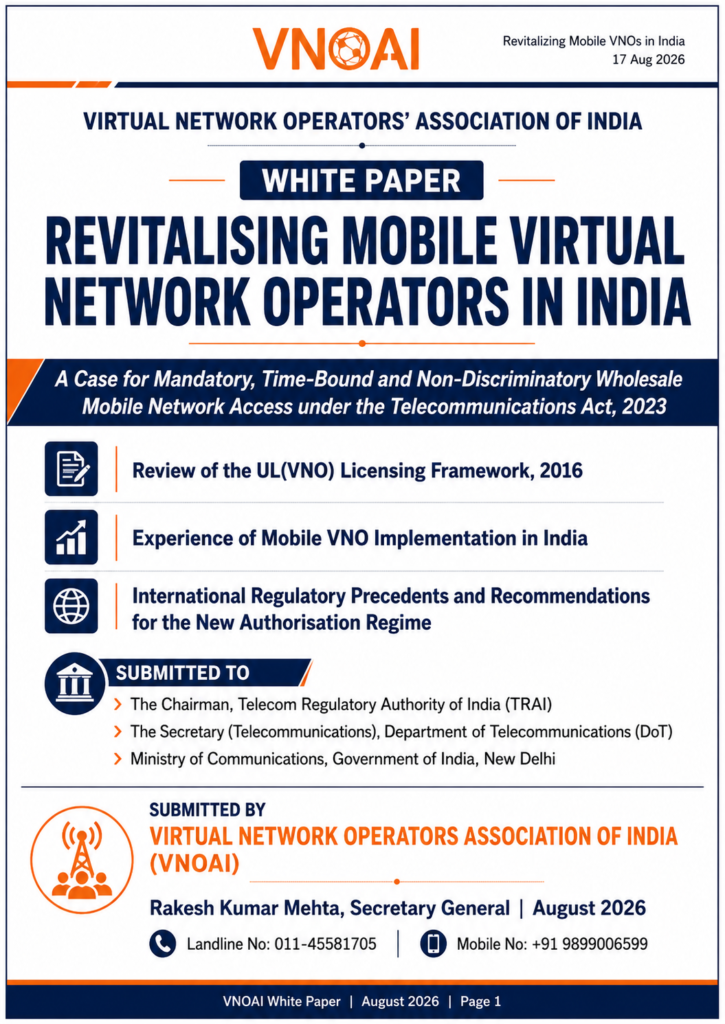
A Case for Mandatory, Time-Bound and Non-Discriminatory Wholesale Mobile Network Access under the Telecommunications Act, 2023
Download the Full White Paper Here
The Virtual Network Operators Association of India (VNOAI) has prepared a comprehensive White Paper titled “Revitalising Mobile Virtual Network Operators in India”, calling for a fresh regulatory review of India’s Mobile VNO/MVNO framework and the introduction of an effective wholesale mobile network access mechanism for authorised Virtual Network Operators.
The White Paper, dated 17 August 2026, examines nearly a decade of experience since the introduction of the Unified Licence for Virtual Network Operators [UL(VNO)] framework in 2016. It reviews the original policy objectives, implementation experience, structural challenges faced by Mobile VNOs, international regulatory models and reforms that may be considered under India’s new telecom authorisation regime. White-Paper-Final-Submitted-TRAI
The paper has been prepared for consideration by TRAI and the Department of Telecommunications (DoT) as India transitions to the regulatory framework established under the Telecommunications Act, 2023.
The Core Issue: A Licence Without Assured Network Access
India’s VNO framework recognised an important concept: competition in telecommunications does not necessarily require every service provider to own spectrum and construct an independent radio access network.
A Mobile VNO can obtain wholesale network capacity from an infrastructure-owning Network Service Operator/Mobile Network Operator and compete through innovative tariffs, customer experience, distribution, enterprise solutions and specialised services.
However, VNOAI’s White Paper identifies a fundamental structural issue in the framework.
While a VNO could obtain a Government licence, pay entry fees, furnish bank guarantees, invest in systems and manpower and assume regulatory obligations, there was no corresponding enforceable requirement on an eligible mobile operator to provide network access within a specified period and on fair and non-discriminatory terms. White-Paper-Final-Submitted-TRAI
The result was that an authorised Mobile VNO could remain unable to commercially exercise the very authorisation for which regulatory and financial obligations had already commenced.
The White Paper therefore asks an important policy question:
Should a Government-issued Mobile VNO authorisation depend entirely upon the commercial willingness of an existing vertically integrated mobile operator to provide the essential network input?
Ten Years of Experience Calls for a Regulatory Review
The White Paper requests TRAI and DoT to undertake an evidence-based review of the Mobile VNO framework after approximately ten years of implementation.
The review should differentiate between VNO models that have developed around wireline and enterprise services and the absence of a meaningful independent Mobile VNO ecosystem in India. White-Paper-Final-Submitted-TRAI
This review is particularly relevant because the Indian mobile market has changed significantly since the VNO framework was conceived.
VNOAI’s paper notes that the market has consolidated substantially and argues that service-based competition through MVNOs can provide additional consumer choice without requiring another operator to acquire nationwide spectrum or duplicate radio infrastructure. White-Paper-Final-Submitted-TRAI
Experience of Early Mobile VNO Implementation
The White Paper also examines the practical experience of early Mobile VNO investors.
Following the introduction of UL(VNO), companies invested in licences, bank guarantees, telecom systems, integration, manpower, billing infrastructure and SIM/eSIM capabilities.
The paper discusses the experience of Mobile VNO licensees that participated in the BSNL VNO process. According to the White Paper, the intended commercial rollout did not materialise within a reasonable timeframe, while the VNO licensees continued to face licence-related obligations and investment carrying costs. White-Paper-Final-Submitted-TRAI
Importantly, the White Paper does not seek to assign institutional blame. Instead, it uses the experience to examine whether the policy framework contained an adequate regulatory safety net for a licensed VNO that could not secure commercially usable mobile network access. White-Paper-Final-Submitted-TRAI
Why Mobile Network Access Is Different from Ordinary Procurement
A Mobile VNO cannot simply replace unavailable mobile network access by purchasing an ordinary input from another vendor.
To create an independent nationwide radio network, the VNO would require spectrum, towers, radio infrastructure, backhaul, core-network integration, rights of way and substantial capital expenditure.
That would effectively transform the VNO into an infrastructure-owning MNO.
The White Paper therefore describes radio/mobile network access as the indispensable upstream input required to exercise a Mobile VNO authorisation. White-Paper-Final-Submitted-TRAI
There is also an inherent commercial tension.
A host MNO can benefit from wholesale revenue generated by a VNO, but the VNO may simultaneously compete with the host operator for retail customers or particular market segments. The paper argues that this vertical relationship is one reason why voluntary access cannot automatically be assumed to produce an effective wholesale market. White-Paper-Final-Submitted-TRAI
MVNOs Can Expand Service-Based Competition
VNOAI believes that Mobile VNOs can complement infrastructure-based competition by allowing more service providers to compete over existing telecommunications infrastructure.
Potential areas highlighted in the White Paper include:
- rural and underserved communities;
- low-income and voice-centric customers;
- senior citizens and students;
- migrant communities;
- enterprise mobility;
- IoT and M2M applications;
- fintech;
- logistics;
- agriculture;
- specialised community services; and
- public-service connectivity.
The objective is not to prescribe a particular tariff or business model, but to allow specialised providers to discover and serve demand that may not always fit the standard offerings of mass-market operators.
What Can India Learn from International MVNO Markets?
A major section of the White Paper examines regulatory experience across several jurisdictions.
The paper reviews models including:
Canada – mandated wholesale MVNO access combined with commercial negotiation and regulatory arbitration.
Peru – statutory MVNO access with non-discrimination requirements and regulatory intervention where negotiations fail.
Mexico – structural and wholesale interventions, including open-access infrastructure.
Europe and Finland – predominantly commercial arrangements supplemented by targeted competition/access remedies where justified.
Saudi Arabia – specific MVNO-hosting arrangements and continuing oversight of wholesale mobile markets.
Australia and New Zealand – examples where commercially negotiated hosting models have developed without universal mandatory-access requirements.
The central conclusion is not that every jurisdiction requires the same model. Instead, the White Paper argues that the appropriate level of regulation depends on whether the underlying wholesale access market is actually functioning. White-Paper-Final-Submitted-TRAI
VNOAI’s Proposed Framework for India
At the centre of the White Paper is a proposed regulatory architecture based on five principles:
MANDATORY ACCESS + COMMERCIAL NEGOTIATION + NON-DISCRIMINATION + TIME-BOUND ONBOARDING + REGULATORY BACKSTOP
The proposal does not seek automatic Government determination of every wholesale tariff.
Instead, VNOAI proposes that eligible authorised Mobile VNOs should have a right to request access from designated host operators, while commercial rates should continue to be negotiated between the parties.
Regulatory intervention would become available where negotiations fail or access is indefinitely delayed. White-Paper-Final-Submitted-TRAI
The White Paper proposes that an authorised Mobile VNO should be able to seek wholesale access on fair, reasonable, transparent and non-discriminatory terms, while leaving the parties free to negotiate commercial consideration subject to regulatory intervention where an agreement cannot be concluded within the prescribed period.
A Mobile VNO Reference Access Offer
One of the important proposals is the establishment of a Mobile VNO Reference Access Offer (MVNO-RAO).
A designated host MNO could be required to publish or comply with a TRAI-approved reference framework covering basic technical, commercial and operational conditions.
The White Paper suggests that such a framework should address matters including:
Technical: RAN access, IMS, VoLTE, 4G/5G, SMS, USSD, data, APN, eSIM, MNP, numbering, emergency services, lawful interception, QoS and testing.
Commercial: charging architecture, deposits, capacity commitments, usage charges, billing, reconciliation, credit terms and disputes.
Operational: onboarding, fault management, escalation, service levels, provisioning, planned outages, technology upgrades and business continuity.
Time-Bound VNO Onboarding
Another important proposal is to replace open-ended negotiation with defined timelines.
The indicative framework proposed in the White Paper includes:
| Activity | Indicative Maximum Period |
|---|---|
| Acknowledgement of access request | 7 working days |
| Initial technical information | 15 days |
| Initial commercial proposal | 30 days |
| Commercial negotiation | 60 days |
| Reference to TRAI if unresolved | After 60 days |
| Technical implementation after agreement | 60–90 days |
| Testing and launch readiness | As per binding implementation plan |
White-Paper-Final-Submitted-TRAI
Such timelines could provide greater certainty to both network operators and prospective VNO investors.
Technology Parity Is Essential
Providing nominal network access may not be sufficient if a VNO is restricted to outdated technology.
The White Paper therefore recommends that when a host operator commercially introduces material capabilities for its own subscribers, corresponding wholesale functionality should also become available to eligible VNOs within reasonable technical timelines and on fair commercial terms.
This could include capabilities such as:
VoLTE, IMS, eSIM, 4G, 5G NSA/SA and future network technologies. White-Paper-Final-Submitted-TRAI
Without such technology parity, a formal right of access could become commercially ineffective.
Wholesale Pricing Should Remain Commercial
VNOAI does not propose a single Government-fixed wholesale tariff.
Instead, the White Paper proposes a four-level structure:
Commercial negotiation → Reference Access Offer → TRAI mediation/dispute resolution → regulatory price determination/arbitration only where necessary.
It also recommends that TRAI retain the ability to examine possible margin squeeze, discrimination or constructive refusal where wholesale pricing makes effective VNO competition commercially impossible. White-Paper-Final-Submitted-TRAI
At the same time, the White Paper recognises the legitimate investments of MNOs, including spectrum acquisition, capital expenditure, network operating costs, security requirements and technology upgrades.
The proposed framework is therefore based on compensated wholesale access, not uncompensated transfer of infrastructure value. White-Paper-Final-Submitted-TRAI
Relief Where VNOs Cannot Launch Due to Absence of Network Access
The White Paper also raises an important issue concerning minimum recurring regulatory financial obligations.
VNOAI proposes that where an authorised VNO has made bona fide efforts to secure network access and has fulfilled reasonable readiness conditions, but cannot commence commercial service solely because qualifying host-network access remains unavailable, minimum recurring financial obligations should be capable of suspension or waiver for the demonstrable period of access failure. White-Paper-Final-Submitted-TRAI
The paper also calls for examination of historic cases to draw policy lessons and consider appropriate relief where legally justified.
An Opportunity Under the Telecommunications Act, 2023
India’s transition from the legacy licensing regime provides an opportunity to address the structural issues identified during the first decade of Mobile VNO implementation.
VNOAI’s White Paper recommends that the new authorisation framework expressly address:
- wholesale mobile network access;
- time-bound negotiations;
- non-discrimination;
- technology parity;
- security responsibilities;
- dispute resolution;
- regulatory monitoring; and
- treatment of minimum financial obligations where essential network access is unavailable.
The paper stresses that a modern regulatory framework should ensure that a Government-created telecom authorisation is practically capable of commercial exercise. White-Paper-Final-Submitted-TRAI
Key Recommendations to TRAI and DoT
Among the principal recommendations made by VNOAI are:
- initiation of a TRAI consultation on wholesale mobile network access for authorised VNOs/MVNOs;
- review of the outcome of the 2015 recommendations and 2016 VNO framework;
- assessment of the wholesale mobile market and appropriate host operators;
- development of an MVNO Reference Access Offer;
- a defined commercial negotiation period, preferably around 60 days;
- fast-track mediation, arbitration or regulatory determination where negotiations fail;
- fair, reasonable, transparent and non-discriminatory access;
- technology-parity and anti-margin-squeeze safeguards;
- monitoring of VNO access requests, agreements, launch timelines and disputes;
- appropriate treatment of historical cases affected by network-access constraints; and
- incorporation of an enforceable wholesale-access principle in the new authorisation regime.
Towards a Sustainable Mobile VNO Ecosystem in India
The introduction of UL(VNO) in 2016 represented an important step towards service-based competition in Indian telecommunications.
The experience of the following decade, however, provides an opportunity to evaluate what worked, what did not, and what reforms are required for Mobile VNOs to become commercially viable.
VNOAI believes that India can develop a balanced framework that protects investment by infrastructure-owning operators while simultaneously enabling genuine service-based competition.
The proposed approach can be summarised as:
Mandatory Access
Commercial Negotiation
Non-Discrimination
Time-Bound Onboarding
Regulatory Backstop
VNOAI has therefore requested TRAI and DoT to undertake a joint review and consider a fair, reasonable, transparent, non-discriminatory and time-bound wholesale mobile network access framework for authorised Mobile VNOs in India. White-Paper-Final-Submitted-TRAI
Read the Complete VNOAI White Paper
The full White Paper provides detailed analysis of the UL(VNO) framework, Indian implementation experience, international regulatory precedents, proposed wholesale-access architecture, onboarding timelines, pricing safeguards and recommendations to TRAI and DoT.