Proposed Discussions with Principal Advisor (QoS) and Advisor (QoS), TRAI – Clarifications on TCCCPR Third Amendment Regulations, 2026
VNOAI proposes to hold discussions with the Principal Advisor (QoS) and Advisor (QoS), TRAI, regarding implementation of the TCCCPR (Third Amendment) Regulations, 2026, particularly the provision allowing a termination charge of up to 5 paise per minute on A2P calls.
Meeting is Schedule in Virtual Mode link will be shared at 4:00 PM onwards on 19/10/2026.
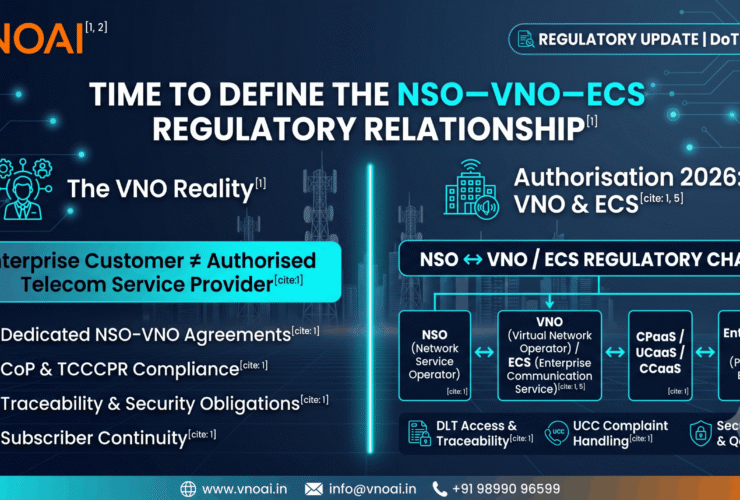
As VNOs are recognised Access Providers under TCCCPR, certain clarifications are essential to ensure uniform implementation, fair competition and non-discriminatory treatment vis-à-vis Network Service Operators (NSOs).
The following key points are proposed for discussion with TRAI:
- Applicability of 5-Paise Charge to VNOs: Clarify whether the VNO or its parent NSO will be treated as the Originating Access Provider for billing and settlement of the A2P termination charge, and ensure there is no duplicate levy.
- Definition and Identification of A2P Calls: Clarify the applicability to SIP/PRI, cloud telephony, API-assisted calls, click-to-call, agent-assisted calls, delivery services and customer-initiated callbacks, particularly where live human interaction is involved.
- On-Net and Off-Net Calls: Clarify the treatment of A2P calls terminating within the parent NSO’s network compared with calls terminating on other networks, and ensure competitive neutrality between VNOs and NSOs.
- Non-Discriminatory Charges: Clarify how VNOs can obtain the benefit of Regulation 35A’s safeguard linking the termination charge to the TAP’s lowest applicable tariff offered to its directly connected Senders/Telemarketers.
- Exempted Numbering Series: Clarify the practical availability and implementation of 140xx, 1600xx and 1601xx series for eligible VNO enterprise customers, including number allocation, routing and exemption from termination charges.
- DLT Platform Access: Seek directions for mandatory, real-time DLT access to VNOs through their NSOs under the amended Regulation 13, covering A2P declarations, consent management, UCC complaints and regulatory reporting.
- NSO–VNO Operational Responsibilities: Clarify the respective responsibilities of NSOs and VNOs regarding CLI declaration, traffic identification, CDR exchange, complaint investigation, blocking and compliance actions.
- Billing, Settlement and AGR: Seek clarification on the billing methodology, per-minute pulse calculation, audit rights, treatment of disputed charges and applicable AGR/accounting treatment, without duplicate recovery through NSO–VNO arrangements.
- Implementation Guidelines: Request a uniform Code of Practice, standard NSO–VNO operating procedures and adequate implementation arrangements before enforcement.
Objective of the Discussions
To obtain suitable written clarifications and operational directions from TRAI ensuring that VNOs, as duly authorised Access Providers, can comply with the amended regulations without suffering unintended competitive or financial disadvantages compared with NSOs directly serving enterprise customers.
Members are requested to provide their observations, practical difficulties, sample use cases and estimated financial impact so that VNOAI can consolidate the industry’s concerns for presentation to TRAI.
Click to Download the Letter Copy